

The Virtual Human Platform for Safety Assessment (VHP4Safety) aims to to transform the evaluation of chemical and pharmaceutical safety by replacing animal testing with human-based methods. Traditional approaches raise ethical concerns and often fail to predict human biological responses. VHP4Safety integrates computational and experimental models using human data for more accurate, ethical, and effective assessments.
The project has three research lines:
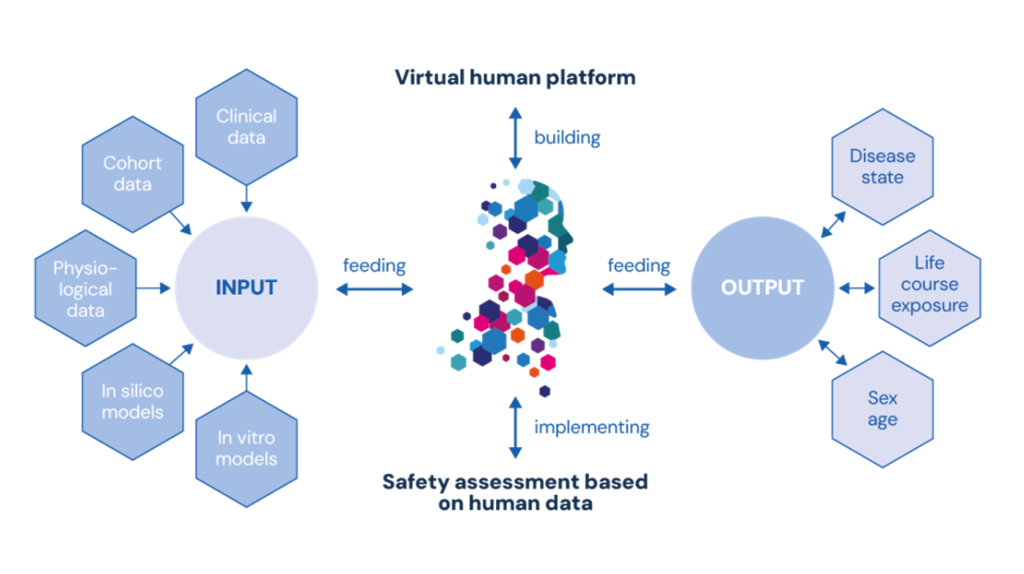
Focus areas include chronic kidney disease, lifelong chemical exposure (linked to neurodegeneration), and thyroid-related developmental neurotoxicity, mapped via adverse outcome pathways (AOPs) to trace how chemical exposure causes adverse effects. Advanced in vitro methods (e.g., iPSCs) and human exposure data (e.g., epidemiology) feed into in silico models to predict safety outcomes.
hDMT is involved in the research line on implementing the VHP. hDMT participated in Designathons and the project meeting and reflects on input on criteria for implementation of the methods developed in VHP4Safety. hDMT will also be involved in training and educational activities of the VHP4Safety project.
The VHP4Safety project aims to revolutionize chemical and pharmaceutical safety assessments with a robust human biology-based platform. Its objectives are to replace animal testing with ethical, predictive methods and tackle safety challenges in human-relevant scenarios.
The project focuses on building computational models, generating data using advanced in vitro methods (e.g., human iPSCs), and integrating this into in silico models. Key goals include understanding impacts of diseases, life-long chemical exposure, and sex- and age-specific differences, explored through case studies on chronic kidney disease, neurodegeneration, and developmental neurotoxicity. Adverse Outcome Pathways (AOPs) guide the mapping of chemical effects, while collaboration with end users ensures practical adoption.
By advancing New Approach Methodologies (NAMs), VHP4Safety promotes ethical innovation, and delivers tools for sustainable, accurate safety assessments.
The VHP4Safety project is set to transform safety assessments by providing human-relevant alternatives to traditional animal-based methods.
The platform’s human-centered approach will improve public health protection and support regulatory decisions by better reflecting real-world biology. By focusing on chronic diseases and developmental toxicity, the project tackles gaps in understanding long-term chemical effects.
Its collaborative design ensures wide adoption by scientists, industry, and regulators, enabling a smoother transition to animal-free methods. Long term, VHP4Safety supports sustainable innovation, aligning with global goals for ethical science and environmental stewardship.
Recent highlights of the VHP4Safety project include:
A list of all publications in the VHP4Safety project can be found here: The Virtual Human Platform for Safety Assessment | NWO
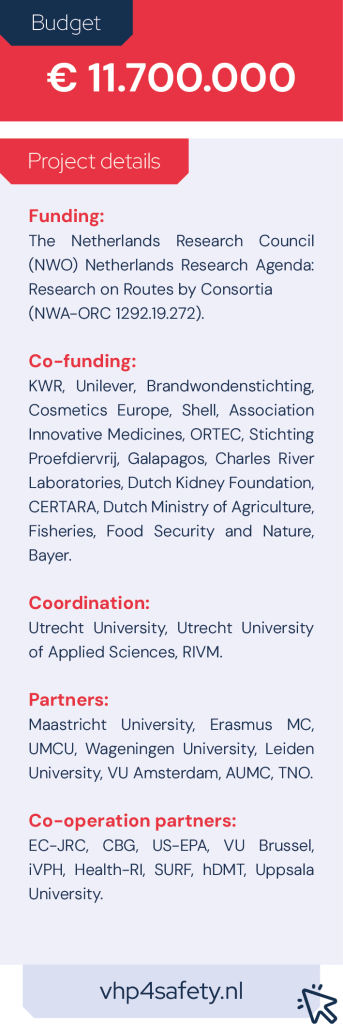
Project period 2021-2026


Research
Publications
Scientist in the spotlight
Blog
Funding opportunities
hDMT Agenda
Click here for our cookie policy.