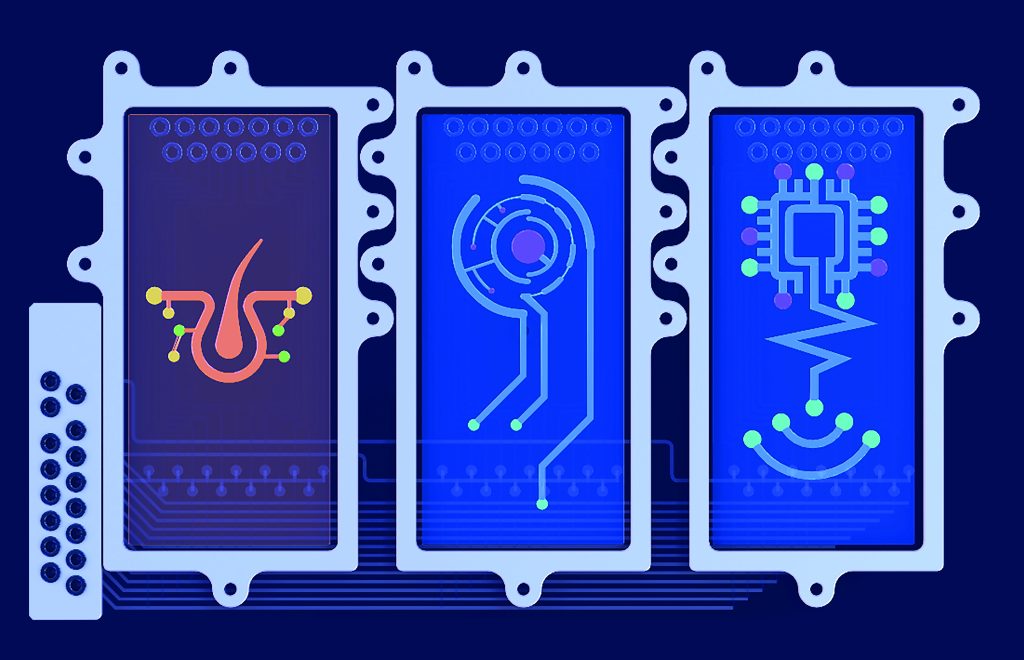


Organ-on-Chip is a game-changing approach in which human cells are cultured in microfluidic chips simulating and predicting the response of healthy and diseased human tissues.
Despite its promise, Organ-on-Chip adoption is hampered by profound technical and functional limitations. In this multidisciplinary program, engineers and biomedical researchers from 8 universities join forces with 27 users to overcome these limitations by developing a novel, Standardized, open and Modular Organ-on-Chip (OoC) Approach to Recapitulate Tissues (‘SMART OoC’).
Our key aim is to develop a standardized microfluidic SMART docking plate into which technical and tissue chip modules can be plugged to form an integrated easy-to-use Organ-on-Chip platform that is compatible with (automated) workflows of biologists and drug developers, and that supports the development and the application of medical drugs and toxicity testing.
The research in the SMART OoC project is jointly carried out by 10 research groups from 8 different universities: TU Eindhoven (project leader), UTwente, TU Delft, Leiden University, AUMC, MUMC+, WUR, and UMCU. 27 Users actively participate in the project. The project has an Industrial Advisory Board with representatives of 6 big pharmaceutical companies.
hDMT has been indispensable for the birth and project management of the project. hDMT coordinated the proposal writing and building the user group. hDMT is formal user of the group, and supports the project leader with project management.
Development and integration of (i) a standardized microfluidic SMART docking plate into which chip modules can be plugged; this docking plate will follow the ISO 22916:2022 standards for microfluidic devices; (ii) technical chip modules for microfluidic pumping and sensing where we focus on biomarker sensing using surface-enhanced Raman scattering (SERS) and barrier tissue property characterization using trans-epithelial resistance (TEER) ; (iii) readout technologies for multiparameter monitoring, focusing on markers that are relevant for fibrosis; and (iv) prototype tissue chip modules with 3D organ architectures and integrated tissue microenvironment; three tissue models are being developed in parallel: skin, gut, and joint. The partners will (v) demonstrate functionality of the SMART OoC models using clinically relevant biomarkers in the context of fibrosis.
SMART OoC provides a conceptually novel solution for the pharmaceutical, food, chemical, and cosmetics industries’ urgent need for physiologically relevant human-relevant models to test the efficacy and safety of new drugs, chemicals and cosmetics. End user adoption of SMART OoC will be accelerated due to its compatibility with automated workflows and large-scale manufacturability. As a result, the SMART OoC will have strong economic impact on these multi-billion industries. Moreover, it will contribute to improving diagnostics and therapies, while reducing health care costs, animal testing, and – eventually – improving quality of life for all.
The project’s progress is monitored by means of an ‘impact plan’, and active involvement of many industrial partners, ensuring valorization. Additionally, impact is achieved by publications and training of young researchers that will drive the future of Organ-on-Chip science.
A recent achievement is the ‘SMART Starter Kit’, which is a first version of the ISO 22916-compatible SMART OoC platform. The Starter Kit includes the docking plate with connections for chip modules, integrated pumping, and reservoirs. Starter Kits have been shipped to project partners as a platform for developing technical and tissue chip modules. The SMART OoC Starter Kit has been demonstrated at several conferences, such as EUROoCS 2024 in Milan and MPS World Summit 2024 in Seattle. Also, major progress has been made in developing a pumping chip, as well as initial versions of skin, gut and joint tissue chips.
The project has led to several co-development activities with industrial partners from the user group. Finally, the research has resulted in a start-up company, ARTIC, on microfluidic pumping for Organ-on-Chip platforms.


Research
Publications
Scientist in the spotlight
Blog
Funding opportunities
hDMT Agenda
Click here for our cookie policy.