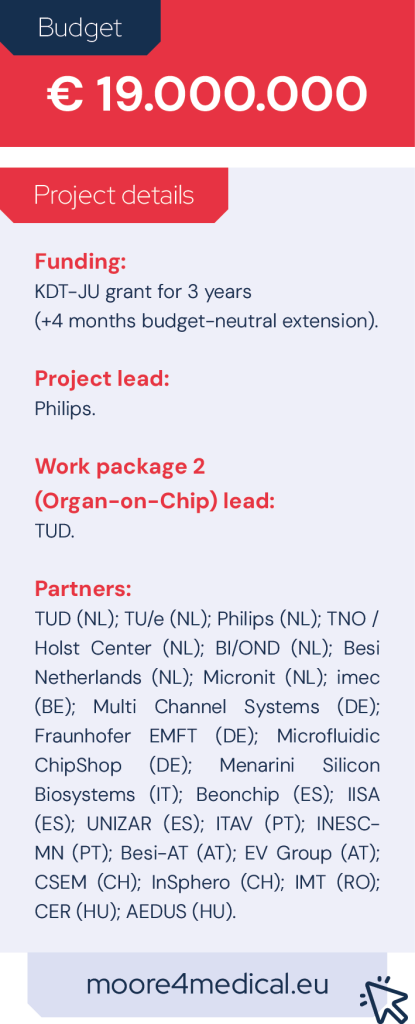


The Moore4Medical project aimed to demonstrate the technological relevance and socio-economic benefits of the adoption of Open Technology Platforms (OTPs) in the field of electronic medical devices. The project developed three open Organ-on-Chip technology platforms with a technological readiness level (TRL) of at least 5, namely the smart multi-well plate, the high-density electrophysiology plate, and the smart (multi-well plate) lid.
Collaboration and technology transfer between European industrial and academic partners was essential in driving progress, and the project laid the groundwork for two follow-up initiatives: the European Chip-JU UNLOoC project and the Dutch NXTGEN Hightech Biomedical Production Technology project 3 focusing on Organ-on-Chip. These projects aim to further advance OTPs and push the field forward.
Coordination of Dutch partners, member of Advisory Board, contacts with regulators and EUROoCS, supervision of alignment with roadmap for Organ-on-Chip development and standardization initiatives.
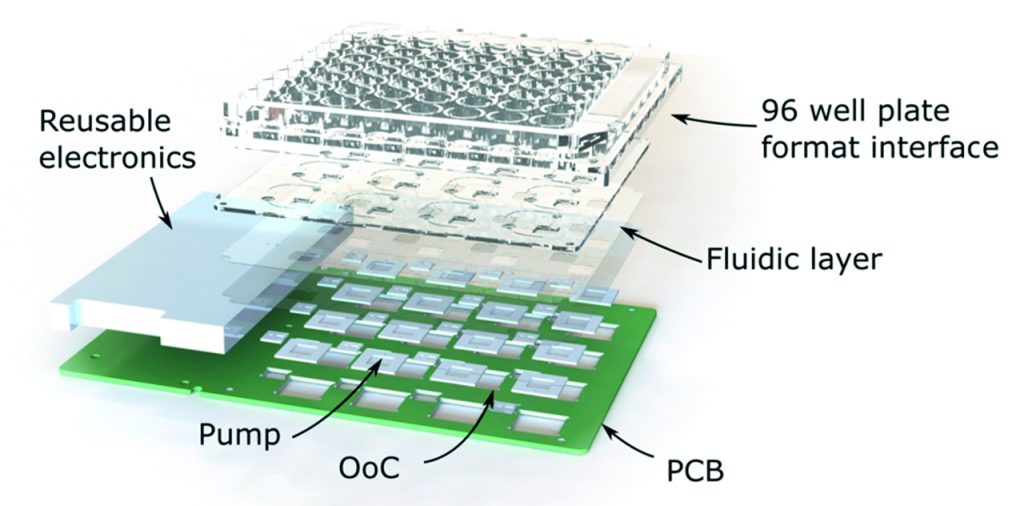
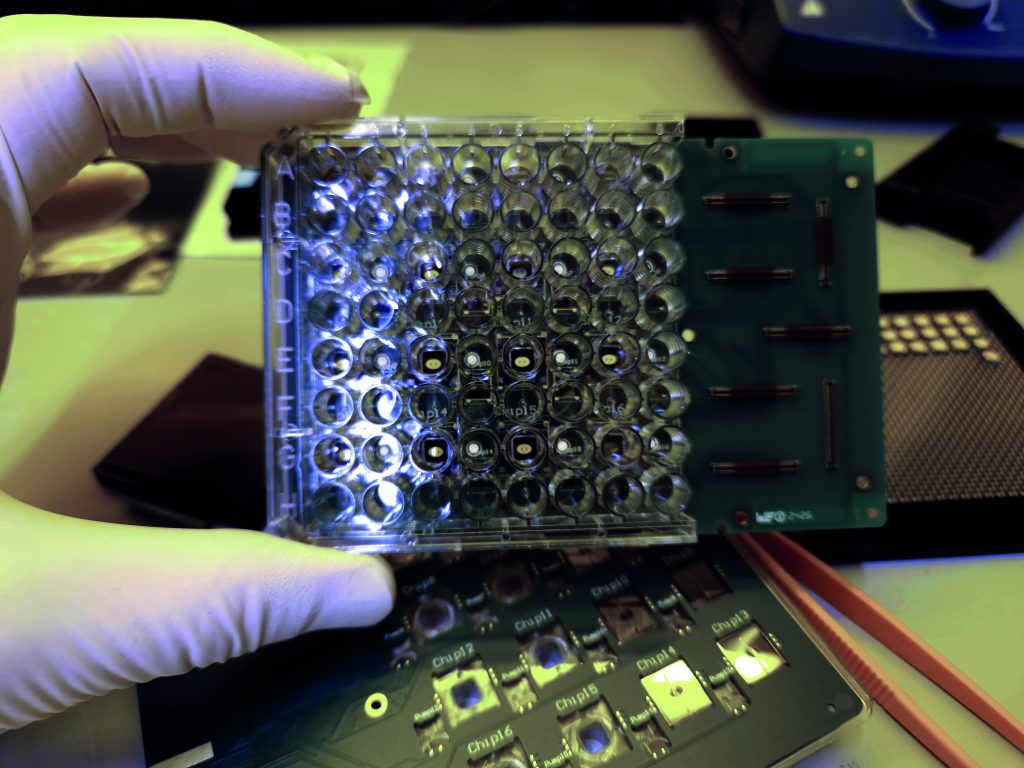
Moore4Medical’s second work package targeted the development and preliminary qualification of (Open) Technology Platforms for tailored Organ-on-Chip applications. Along with the 384-well version of the Akura plate from InSphero for high-throughput spheroid co-culture, the Organ-on-Chip platforms included the modular and fluidically-autonomous Smart Multi-Well Plate (SMWP), the high-density electrophysiology plate from imec, and two versions of the Smart Lid from CSEM tailored respectively for the Akura plate and the SMWP. The technology platforms and corresponding demonstrators were conceived as proof of technological feasibility and manufacturing advantage inherent to the concept of platform. The concept itself is inherited from the microelectronics domain and is expected to push forward the progress in standardization, modularization and interfacing in Organ-on-Chip. This will help addressing relevant challenges at once, such as ease of use, fit-for-purpose, standardization, interoperability, and scalable manufacturing.
Organ-on-Chip technology includes a wide range of applications, partners, and proposals, with various devices used in labs and made commercially available. This variety reflects the diversity of organs and tissues, but can also hinder interoperability and interfacing among devices without proper guidelines. Moreover, scalable manufacturing is essential for reproducible and cost-effective fabrication of the devices.
Open technology platforms ensure standardization, modularity, and scalable production. These platforms target potentially very-large pharmacological and chemical markets, and can transform pre-clinical drug development with faster, more effective outcomes and significant societal benefits.
The Organ-on-Chip platforms developed by Moore4Medical were successfully qualified in relevant environments, reaching a TRL of at least 5. Main highlights include liver and pancreas spheroid co-culture using the Akura 384-well plate by InSphero, and the monitoring of the co-culture by means of the sensors integrated into CSEM’s Smart Lid; the monitoring of electrical activity of cardiac tissues in imec’s high-density electrophysiology plate; and the establishment of neuronal, cardiac and skin models respectively by MCS, BI/OND and Beonchip in tailored versions of the Smart Multi-Well Plate assembled by Micronit.
These achievements, detailed in a white paper available on the project website and in peer-reviewed journals, were accompanied by the establishment of a strong and dynamic network of collaborations among the partners. This outstanding foundation prompted two follow-up projects which aim to further develop the Smart Multi-Well Plate for diverse applications.


Research
Publications
Scientist in the spotlight
Blog
Funding opportunities
hDMT Agenda
Click here for our cookie policy.