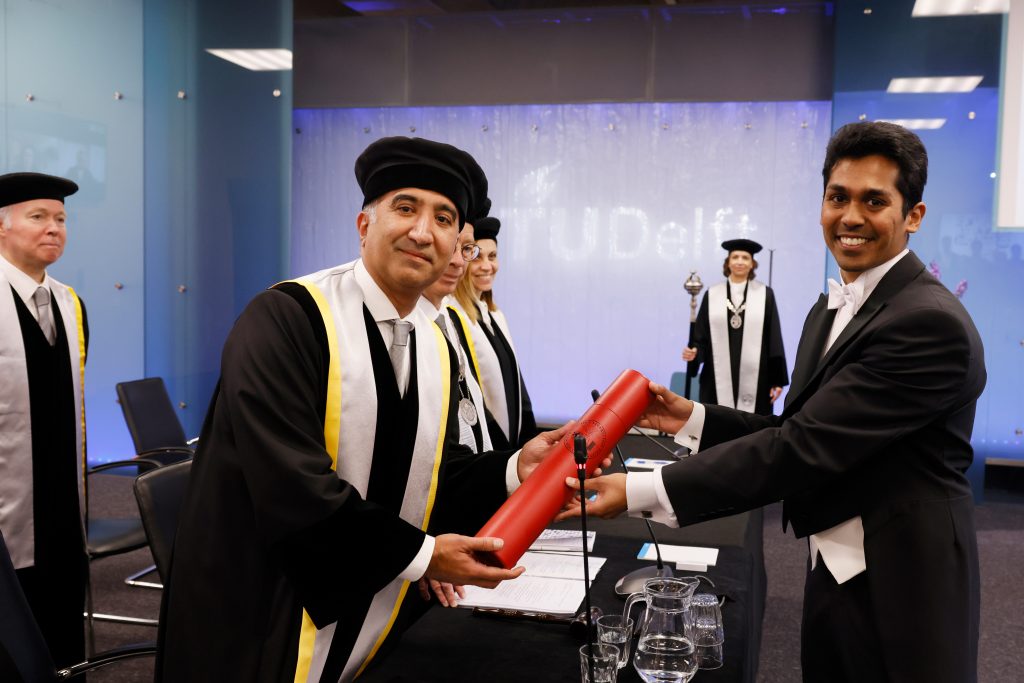
On October 2nd, 2024, Zaid Rahman successfully defended his thesis entitled “3D in vitro Cancer Models: Combining Biophysical and Biochemical Cues” at Delft University of Technology under the supervision of promotor Pouyan Boukany and Prof. Dr. Valeria Garbin. During his PhD, he developed a 3D-microfluidic model to embed lung cancer (A549) spheroids within a hydrogel matrix to closely mimic the biomechanical properties of the tumor microenvironment (TME). This 3D-microfluidic platform allowed him to introduce interstitial flow (biophysical cue) and Transforming Growth Factor (TGF)-β (biochemical cue). The combination of these factors revealed a synergistic effect on the upregulation of TGF-β induced intra-cellular signaling pathways and upregulation in Vimentin protein expression, a key mesenchymal biomarker in cancer progression in lung cancer spheroids.
In collaboration with Koendrink lab (Department of Nanobiology at TU Delft), he characterized varying biomechanical factors of collagen-based matrices and quantified the spheroid invasion capacity of epithelial-like lung cancer (A549) and mesenchymal-like (MV3) melanoma cancer cells. He revealed that the matrix pore-size plays a dominant role in modulating cancer cell invasion compared to matrix stiffness. This research highlighted the importance of cell-matrix interactions and provided new insights that connected a biological phenomenon (epithelial to mesenchymal transition) to a biophysical event (unjamming transitions).
In his PhD, he addressed the importance of using 3D in vitro models by showcasing the interplay between biophysical and biochemical cues in a TME on early invasion events in cancer metastasis.