
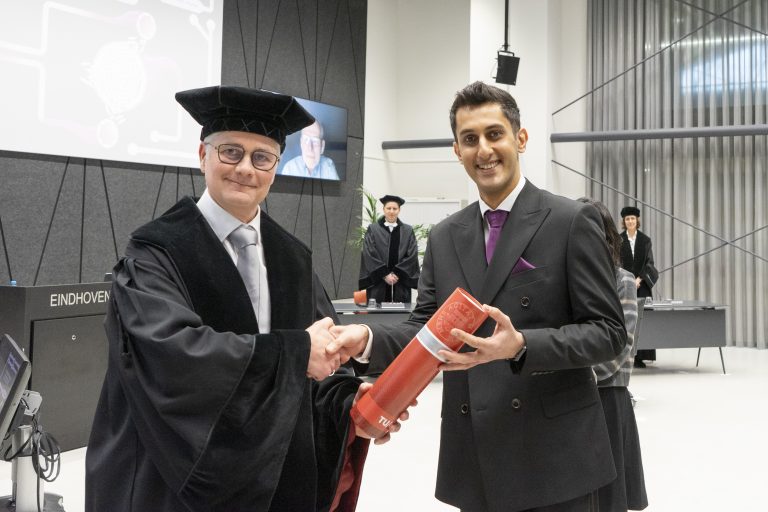
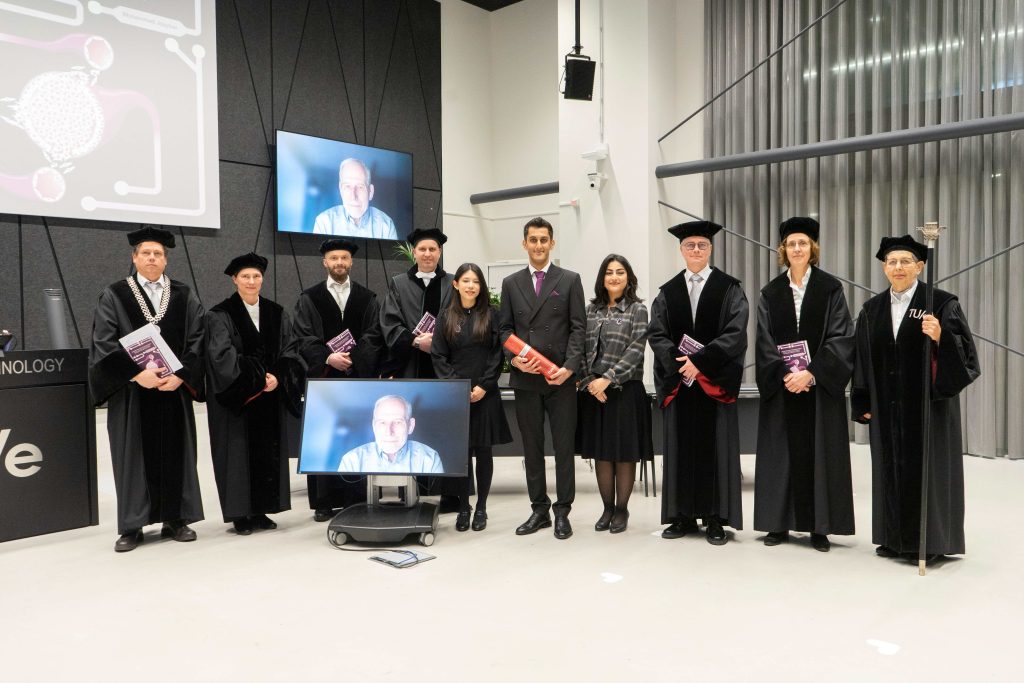
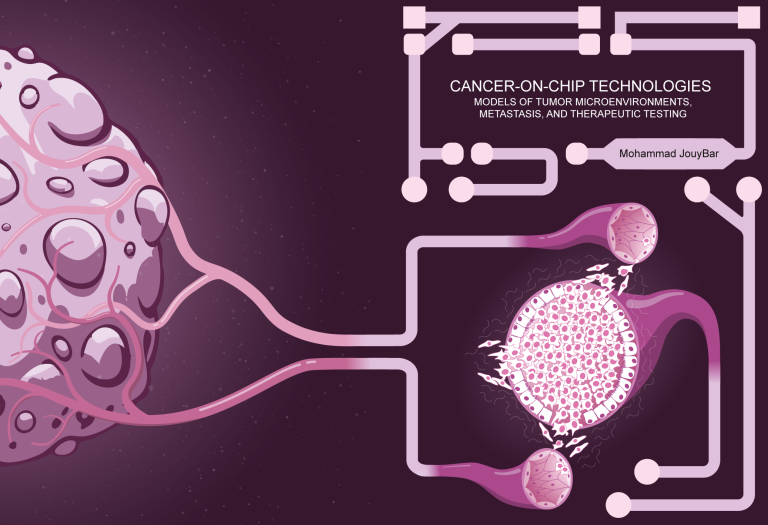
On February 7th, Mohammad Jouybar successfully defended his PhD thesis entitled “Cancer-on-Chip Technologies: Models of Tumor Microenvironments (TME), Metastasis, and Therapeutic Testing” at the Eindhoven University of Technology.
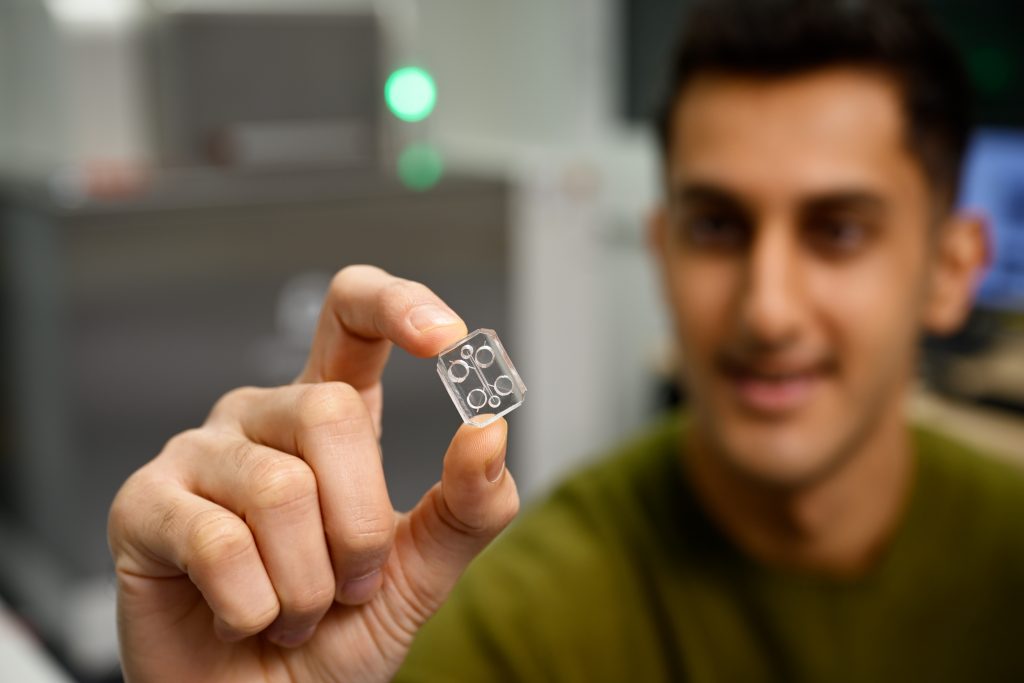
His research focused on advancing Cancer-on-Chip systems to better replicate tumor conditions and evaluate therapeutic strategies. [1] To examine cancer cell invasion, a critical step in metastasis, a droplet microfluidic method was developed to mimic the transition from a soft basement membrane to a stiffer stromal matrix. Using a breast cancer model, the results demonstrated that cancer invasion in this heterogeneous matrix was different from uniform hydrogels. [2] In an improved version of this technique, a breast duct-on-chip model was developed to study ductal carcinoma in situ (DCIS) and invasive ductal carcinoma (IDC), uncovering distinct cancer cell invasion patterns from epithelium.
Next, the research integrated tubular channels with circular cross-sections into Cancer-on-Chip systems to replicate natural vessel geometry. By utilizing 3D sugar printing, microchannels were fabricated to study endothelial cell alignment in response to the channel geometry under different flow conditions. [3] Additionally, the study introduced the “Lumina-Chip,” a versatile Cancer-on-Chip device incorporating both tubular and matrix channels to model cancer invasion and intravasation. [4]
In collaboration with researchers at Amsterdam UMC, a Lymphoma-on-Chip model was developed to investigate the immune microenvironment of diffuse large B-cell lymphoma (DLBCL). [5] This system incorporated lymphatic endothelial cells (LECs), fibroblastic reticular cells (FRCs), and DLBCL cells, revealing that FRCs promote tumor cell survival, migration, and lymphatic vessel permeability. The thesis also explored therapeutic applications using Cancer-on-Chip systems, including conventional chemotherapy drugs and emerging CAR-T cell treatments.
Overall, this thesis presents Cancer-on-Chip models that replicate key aspects of the TME, providing insights into cancer progression and therapeutic responses.
The research was performed under the supervision of Prof. Jaap M.J den Toonder and Prof. Regina Luttge. Mohammad established several collaborations both within and beyond Eindhoven University. The most notable was his collaboration with Dr. Lotte de Winde and Prof. Reina E. Mebius (Amsterdam UMC) on the Lymphoma-on-Chip model, initiated through hDMT.
On the occasion of World Cancer Day (February 4th), read Jouybar’s recent interview with Eindhoven University of Technology here!
Mohammad is currently continuing his research as a postdoc in the group of Prof. Jos Malda at UMC-Utrecht, focusing on robotic arms for multiaxial bioprinting of orthopedic and cardiac tissue, while continuing his adventure with chip models.
1] Jouybar, Mohammad, et al. “Cancer-on-chip models for metastasis: importance of the tumor microenvironment.” Trends in biotechnology 42.4 (2024): 431-448.
[2] Jouybar, Mohammad, et al. “An in vitro model of cancer invasion with heterogeneous ECM created with droplet microfluidics.” Frontiers in Bioengineering and Biotechnology 11 (2023): 1267021.
[3] Jouybar, Mohammad, et al. “The Impact of Channel Geometry and Flow Regime on Endothelial Orientation and Morphology in Vessel-on-Chip.” Adv. Mater. Technol. 2025, 2401994.
[4] Jouybar, Mohammad, et al. “Lumina-Chip-a tubular lumen-based microfluidic approach for enhanced physiological relevance in modeling cancer metastasis.” Chemrxiv (2024).
[5] Jouybar, Mohammad, et al. “Lymphoma-on-chip model reveals that lymph node stromal cells promote diffuse large B-cell lymphoma survival and migration.” Materials Today Bio (2025): 101544.


